
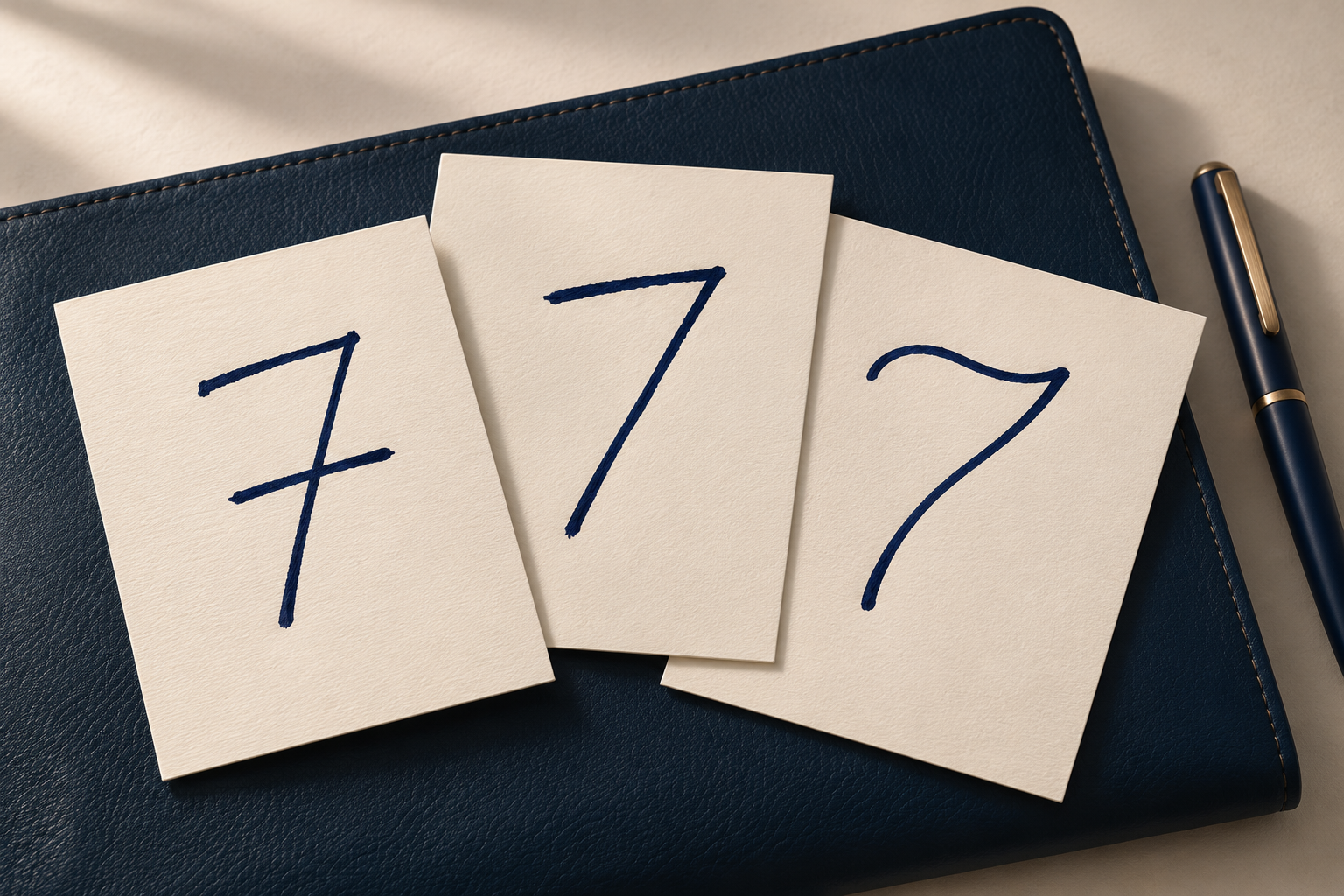
Imagine writing “7” in the quantity box on an order form. You add a line through the middle. Someone else leaves it out. A third person writes it at a sharp angle. You can read all three as seven.
How would you tell a computer which marks mean 7? By describing every possible handwriting style, or by showing it examples?
This fictional order form helps explain “learning” in AI. No coding is needed.
Let’s try writing a rule
Start with a description: “If there’s a horizontal line at the top and a diagonal line going down, call it 7.” That might work for some handwriting. But a curved top, a steep slant or an extra stroke makes the description more complicated.
Taking a shortcut—“A line through the middle means 7”—doesn’t solve it either. Some sevens have no middle line. Handwriting is difficult to capture in a few fixed rules.
Rules are still the right choice for many tasks. Consider another check on the same form: “Quantity must be greater than zero.” Once the number has been entered correctly, a clear condition can handle that check. Not every task needs a learning system.
Show examples instead of extending the description
Try a different approach. We collect images of digits written by different people, each paired with the correct answer: this is 7, this is 1, this is 4. That answer is the example’s “label.”
The system makes predictions from these images. They are compared with the correct answers, and numerical settings are adjusted to reduce the difference. This repeats across many examples. Instead of writing a separate description for every handwriting style, we let the system learn relationships from data.
The general approach is called . Here, we’re describing a method that provides the correct answers too; not all machine learning works this way.
The images and their answers make up the in our example. The mathematical structure that uses learned relationships to produce a result for a new image is called a . Its numerical settings are shaped during training. Reading a new image does not, by itself, train the model again.
“Learning” here doesn’t mean thinking like a person or understanding what a digit means as we do. It means establishing useful relationships between numerical information in an image and the correct answers. Those relationships can still produce wrong results.
The real test is unfamiliar handwriting
If we only show the system one person’s neat handwriting, it may struggle with someone else’s hurried 7. Examples need to represent the conditions where it will be used. Duplicating one neat image cannot replace varied handwriting.
That’s why we don’t check performance only on the training images. We also use images set aside beforehand, which were not used in training. This separates success on familiar examples from success on new ones.
Using what it has learned on new examples under similar conditions is called . That doesn’t guarantee success in every unfamiliar situation. Blurry photos or very different handwriting can change the result.
Reading a few neat digits in a demonstration is not enough evidence. Test the handwriting you actually encounter, examine the errors and include human checks where they matter.
A two-minute paper experiment
Write three different versions of 7. Try to describe all three with one short rule. Then ask someone to write a 7 and a 1 without seeing yours. Does your rule recognise their 7 while ruling out their 1?
This doesn’t train a model. It shows why a description based on a few familiar examples can struggle with a new one. No technical setup or paid tool is needed.
When assessing an AI feature, ask: “Does it only succeed on the examples in the demo, or also on the new examples we will encounter?” That answer matters more than an impressive demonstration.
Both approaches can work together: a learned model reads the handwriting, while explicit rules check the resulting number. A useful solution matches each approach to the task.
How does recognising a digit connect to writing a new sentence? Next, we’ll explore how learning from examples extends to generating content.
Sources
This is your personal note, not a comment or a message to us. It is stored only for this site on this device and browser; it is not sent to a server, analytics system or AI service. Clearing browser data may erase it; it does not sync across devices.