
What Is Innovation? Turning an Idea into Real Value
You leave your device at a repair shop. Three days pass, and you still do not know when you can collect it. You call:
“Your repair is in progress.”
The shop launches a new app. You download it, create an account and register your device. The screen shows the same information:
“Your repair is in progress.”
There is a new app. But you still do not know when you will get your device back.
This brings us to an important question when evaluating : How does our new solution change someone’s work or everyday life?
What does innovation mean?
Innovation means putting into practice a product, service or way of working that differs meaningfully from what existed before.
A new product must be made available to users, and a new working method must actually be implemented. Describing the idea or preparing a presentation is not enough. The OECD and Eurostat’s Oslo Manual emphasises these two points: meaningful novelty and implementation.
The difference between creativity, invention and innovation
Imagine we want to improve a suitcase that has no wheels.
means coming up with a new idea.
“What if we added wheels and pulled the suitcase instead of lifting and carrying it?”
means developing a solution that did not previously exist.
For example, designing an entirely new wheel mechanism and making it work.
Innovation means bringing a meaningful new development into use.
Producing the wheeled suitcase and making it available for people to use.
There is an important detail here: Innovation does not always require a new invention. You can also change how a suitcase is carried by adapting wheels that already exist.
Generating an idea, developing a new solution and making it available for use are different activities. They can complement each other.
What should change at the repair shop?
If the shop sees its problem as “Customers call too often,” it might hire more people to answer the phone.
If it sees the problem as “Customers do not know what is happening or how long they will have to wait,” other solutions become possible:
Clearly explain which stage the repair has reached.
Provide a realistic estimated collection window.
Notify customers about delays before they need to call.
Deliver information through a channel customers can easily access.
The goal becomes clear: Reduce the repeated effort customers make to get an update.
The solution’s value proposition is simple: “Know the status of your device without having to call again.”
Does it have to be a world first?
No. An approach already used by another business can be an innovation for yours if it differs significantly from your previous way of working.
Nor does it necessarily require artificial intelligence or a large technology investment. A significant change in how work is carried out can be . Not every minor adjustment qualifies: changing a screen’s colour and changing what customers can do are different things.
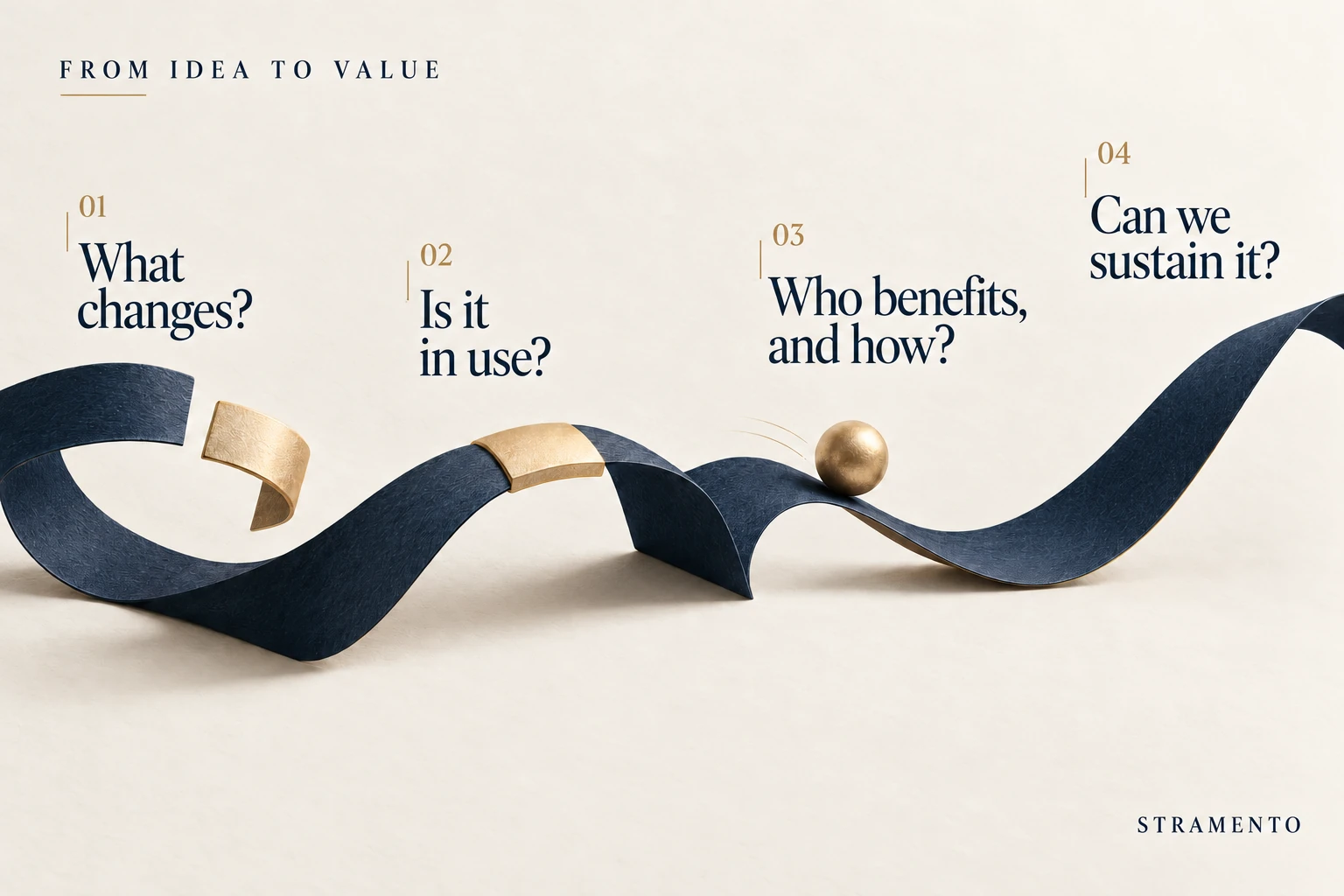
Evaluate your idea with four questions
1. What changes?
Describe the actual difference from the previous situation.
For example: “Customers will no longer need to call the shop to discover that their collection date has changed.”
Saying “We will become more modern” does not explain what will change.
2. Is it in use?
Is there a sample screen, or an operating service?
If employees are updating the information and customers can access it, the idea has been put into practice.
3. Who benefits, and how?
Do customers make less effort? Are employees interrupted less often? Are errors or uncertainty reduced?
Benefits are not limited to money. Saving time, feeling confident and making less effort also matter.
4. Can we sustain it?
Who will update the information? How much time and money will it require? Will it still work on busy days?
If every notification requires checking five separate files, you may be making the customer’s life easier while making the employee’s job harder.
Being new does not guarantee success
Even after implementation, a new solution may fail to deliver its expected benefits. The outcome of innovation cannot be guaranteed in advance.
So, at the repair shop, go beyond saying, “We launched the new system.” Are repeat calls decreasing? Is the information accurate? Is the staff time required reasonable? Check these things.
Now consider your own idea and complete this sentence:
“I want to reduce the problem of …… experienced by …… by changing ……. I will assess whether it works by looking at …….”
If you can complete that sentence clearly, you have a useful starting point for turning your idea into a small test.
This is your personal note, not a comment or a message to us. It is stored only for this site on this device and browser; it is not sent to a server, analytics system or AI service. Clearing browser data may erase it; it does not sync across devices.