
Imagine opening a café.
The coffee is good. Your team is attentive. Customers queue up in the morning.
From the outside, business looks healthy.
But at the end of the month, once you have paid the bills, there is less money left than you expected.
The café across the street keeps running promotions. Your coffee supplier has raised its prices. Customers can easily switch over a small price difference. Another café may be opening nearby. And some of your regulars have started making coffee at home and bringing it to work.
You have customers. You have sales. But several different pressures are affecting what you earn.
helps you see these pressures together.
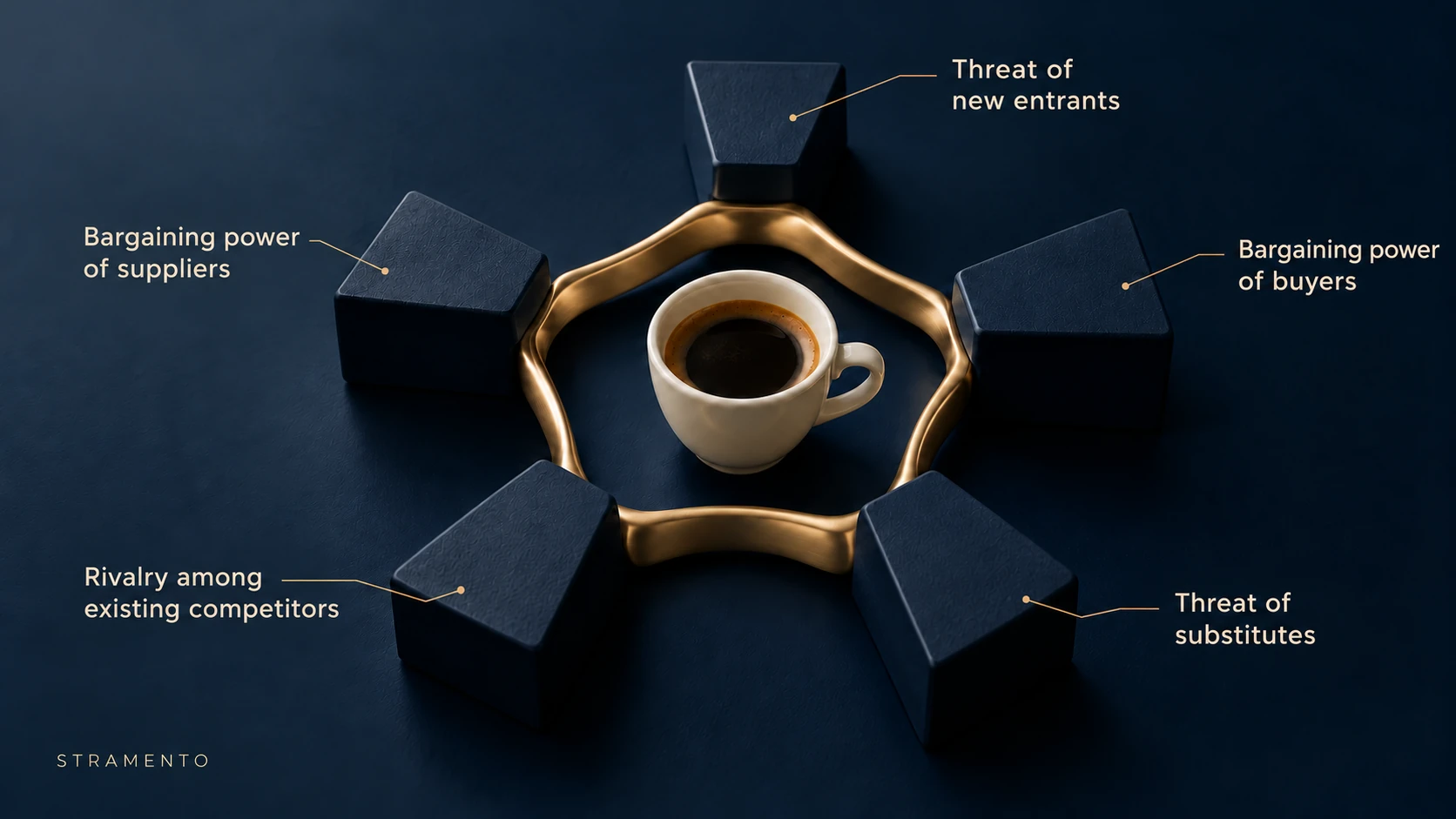
What is Porter’s Five Forces?
Developed by Michael Porter, this framework examines five forces that shape competition and profitability within an industry.
It goes beyond asking, “Who are my competitors?” It also considers suppliers, customers, businesses that could enter the industry, and alternative ways of meeting the same customer need.
The central question is:
“What makes it difficult to earn a profit in this industry—and to sustain it?”
It helps to distinguish revenue from profit. Revenue is the income generated by sales. Profit is what remains after expenses. If your expenses grow faster than your revenue, you can sell more and still earn less.
Let’s explore the five forces through the same café example. This is a hypothetical scenario involving cafés serving people who buy their morning coffee in a business district.
1.
Question: How intense is the competition for the same customers?
Imagine several cafés on your street offering similar coffee. One cuts its prices. Another offers a second drink for free.
You launch your own promotion to avoid losing customers.
You may sell more coffee, but earn less from each sale.
The number of competitors is only part of the picture. It also matters whether customers see a meaningful difference between the businesses.
Ask yourself:
“If our prices were the same, why would a customer choose us?”
For someone rushing to work, fast and reliable service may be valuable. Having an order ready on time, getting the same quality every visit, and spending less time waiting can all influence their choice.
Before offering another discount, find out why customers choose you—and why they leave.
2. The
Question: How easily could someone else enter this business?
Having few competitors today does not mean you will have few tomorrow.
The investment, premises, permits, experience, and effort needed to attract customers all affect how difficult it is to enter an industry. These obstacles are called .
Your café’s interior design may be easy to copy. The trust you have built with regular customers and your consistent service may take much longer to reproduce.
The question is:
“If a similar business opened tomorrow, what would give customers a reason to stay with us?”
A useful first step is to identify which parts of your business are easy to imitate and strengthen the differences that customers genuinely value.
3. The
Question: How much influence do our suppliers have over prices and terms?
Imagine that only one supplier can provide the particular coffee blend your café uses.
If that supplier raises its prices, switching may not be straightforward. The taste could change, you may need to test new products, and customers might notice the difference.
Having fewer alternatives can leave you with less room to negotiate. The money, time, and effort involved in changing suppliers are known as .
However, a price increase does not automatically mean a supplier has strong bargaining power. It may reflect a broader increase in costs. What matters is whether you have acceptable alternatives and how easily you can switch.
Ask yourself:
“If we could no longer work with this supplier, would we have a workable alternative?”
Explore alternatives before a problem arises. Compare quality, delivery reliability, and payment terms alongside price.
4. The
Question: How much influence do customers have over prices and service terms?
Customers do not have to negotiate at the counter to exert pressure.
If they can find similar coffee a few steps away and see little difference between cafés, they can easily switch when prices rise.
This influence can be more visible in business-to-business sales. If local cafés compete for large office orders, companies buying in volume may ask for discounts or additional services.
Ask yourself:
“How easily can customers replace us, and what would they lose by doing so?”
The aim is to offer something worth choosing.
For a café, that might mean consistently accurate orders, dependable delivery, or a service that makes a customer’s daily routine easier.
5. The
Question: Could customers meet the same need in a different way?
This is one of the most commonly misunderstood parts of the framework.
Another café is a competitor.
Making coffee at home can be a substitute for your service.
A substitute meets the same underlying need in a different way.
If a customer simply wants their morning coffee, making it at home may be enough.
If they want somewhere to meet a friend or hold a short meeting, a flask of coffee may not meet that need.
That is why you need to understand what customers are trying to achieve before focusing on the product itself.
Ask yourself:
“If customers did not buy from us, how else would they meet this need?”
Find out which competitors customers choose, but also investigate whether they have stopped using your type of service altogether—and what they do instead.
How can you remember the five forces?
Picture your café and ask these five questions:
Existing competitors: How are we competing with the businesses around us?
New entrants: Who could enter this business tomorrow?
Suppliers: How dependent are we on the businesses we buy from?
Buyers: How much influence do our customers have over the terms of a sale?
Substitutes: How else could customers meet the same need?
These questions apply to education, software, manufacturing, retail, and consulting as well as cafés. The questions remain the same; the answers change.
How can you apply the model to your own business?
Start by defining what you are analysing
“The coffee market” may be too broad.
“Cafés serving people who buy their morning coffee on weekdays in a particular business district” is a more specific starting point.
Write down the product or service, the customers, and the geographical area you are considering.
Find evidence for each force
Instead of writing “Competition is intense,” describe what you have observed:
“I compared the menus of nearby cafés and found regular promotions on similar products.”
Your evidence might come from customer conversations, supplier quotations, contracts, price lists, or direct observation.
Avoid assuming that a problem affecting your own business is a feature of the entire industry. Investigate what is happening in comparable businesses too.
Assess the pressure
For each force, assess the pressure as low, medium, or high, and explain why.
If you do not have enough information, write “I don’t know yet.” Then identify what you need to investigate.
These categories help organise your thinking. They are not a scientific score predicting success.
Turn a finding into an action
For example:
Finding: We depend on one supplier for our signature coffee blend.
First step: Within the next two weeks, we will request samples and quotations from two alternative suppliers.
Review: We will assess flavour, total cost, and delivery reliability together.
This turns the analysis into a practical aid to decision-making.
What does the model not tell you?
Porter’s Five Forces does not, on its own, calculate how many customers you will attract or how much profit you will make.
You also need to examine customer demand, market size, your costs, and your ability to run the business.
Likewise, a strong competitive force does not automatically mean you should avoid an industry. The customers you serve and the way you differentiate your business also matter.
PEST or PESTLE analysis adds another perspective: how economic, social, technological, and other external changes could affect the business. It can therefore complement a Five Forces analysis.
A small exercise you can start today
Write the five forces on a page.
Add one example from your business under each. Mark the areas where you lack information.
Then answer this question:
“Which condition do we believe is putting the greatest pressure on our profit, and what will we do this week to understand or improve it?”
Your first step could be as small as requesting quotations from two suppliers or asking a few customers why they choose you.
What matters is that the analysis leaves you with a clear next step.
This is your personal note, not a comment or a message to us. It is stored only for this site on this device and browser; it is not sent to a server, analytics system or AI service. Clearing browser data may erase it; it does not sync across devices.