
“If I say something, they’ll be upset. If I don’t, it will happen again.”
A colleague misses a deadline. Someone keeps interrupting you in meetings. A responsibility at home keeps falling to you. You know a conversation is needed, but you keep waiting for the right moment.
Sometimes that moment never comes. Frustration builds. Then a small incident brings out everything you have been holding back.
Knowing what you want to say—and in what order—can make it easier to begin.
The is a four-step framework for giving . It helps you describe the situation, explain its impact and work out what should happen next.
It cannot guarantee how the other person will respond. It can help you approach the conversation with greater clarity, preparation and fairness.
The four steps of COIN
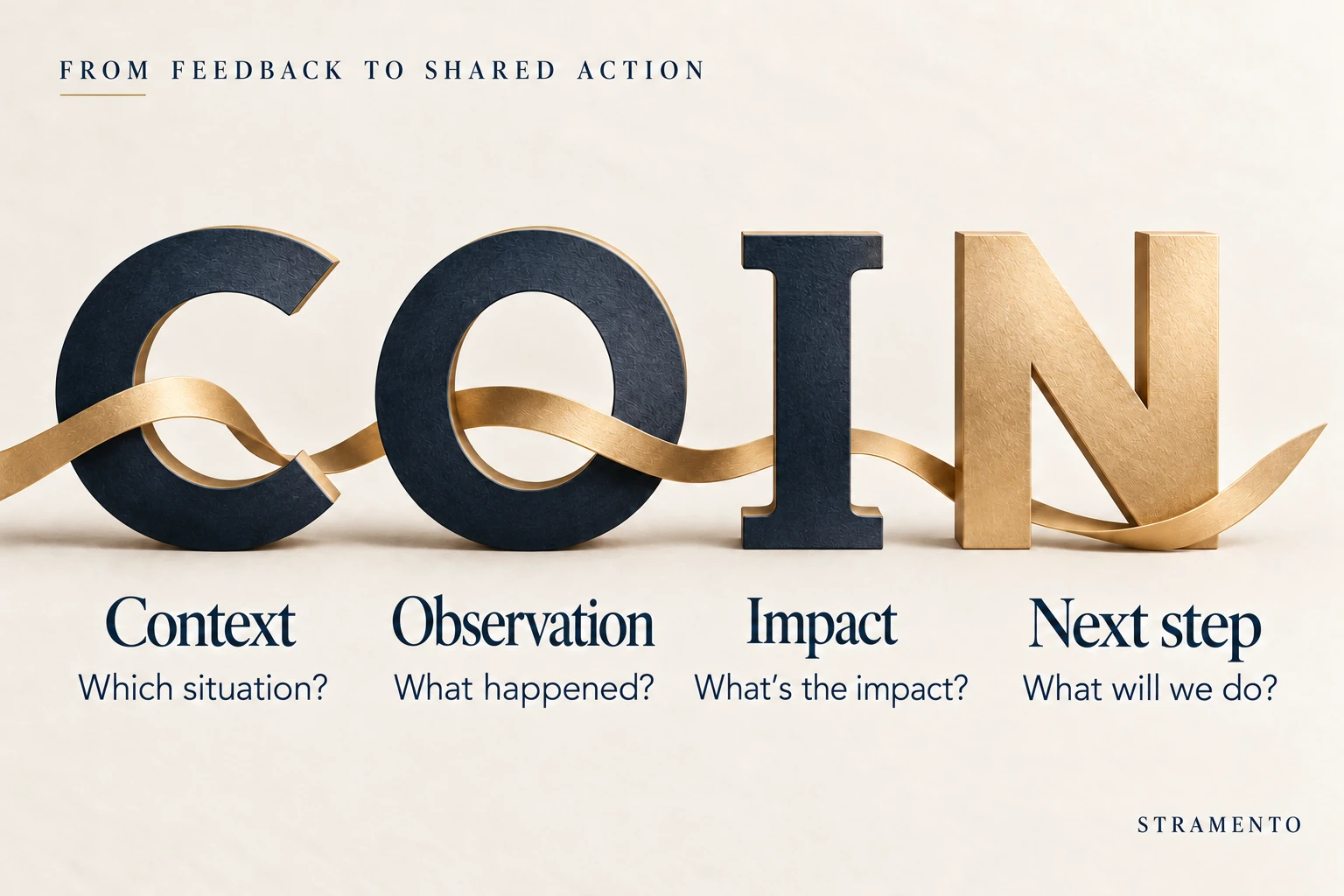
COIN stands for:
C — Context. Which situation are we discussing?
O — Observation. What specifically happened?
I — Impact. What was the result?
N — Next steps. How will we move forward?
Let’s work through an example.
Imagine that a colleague sends you a report at 5:30 p.m., although you had agreed on a 3 p.m. deadline. You had planned to use it in a 4 p.m. meeting.
Your first thought might be:
“You never deliver anything on time.”
That statement leaves the specific incident unclear and judges the person’s entire approach to work.
COIN can help you address the same issue more clearly. Choose a time when you can speak calmly and in private.
1. Context: Narrow the conversation
“Can we talk about yesterday’s report, which we agreed would be ready at 3 p.m.?”
You have identified the situation. You are not bringing every previous delay into the conversation.
2. Observation: Describe what you observed
“The file reached me at 5:30 p.m.”
That is something you can verify.
“You don’t care about your work” is an interpretation of someone’s intentions. You may know the report arrived late. You do not yet know why.
3. Impact: Explain why it matters
“We couldn’t use the figures in the 4 p.m. meeting, so we moved the decision discussion to today.”
The effect of the delay is now clear.
Describe the impact you know about. Keep an actual outcome separate from something you are worried might happen.
4. Next steps: Listen first, then agree
Before suggesting a solution, ask:
“What happened on your side? What made it difficult to finish the report on time?”
You might hear:
“The sales figures arrived late. I didn’t want to send an incomplete report.”
That information changes the solution. You now also need to discuss how missing information will be followed up and when a possible delay will be communicated.
You can check your understanding:
“So you held the report while waiting for the figures, and I only found out about the delay at the deadline. Have I understood that correctly?”
This is a practical example of : trying to understand the other person’s account before preparing your reply.
Then suggest a specific next step:
“For the next report, shall we check for missing figures at 1 p.m.? You can let me know what’s missing, and I’ll follow up with the relevant team. If either of us sees that the deadline is at risk, we’ll flag it straight away. Would that work for you?”
You now know who will do what. After the next delivery, you can also check together whether the arrangement helped.
Small details that make the conversation useful
Choose one issue. Avoid adding unrelated disagreements from months ago to a conversation about a missed deadline.
Check words such as “always” and “never.” Replace them with the situation and behaviour you actually observed.
Stay open to new information. Correct your account if something is missing or inaccurate. Acknowledge anything you contributed to the problem.
Go beyond “be more careful.” Agree on the behaviour that needs to change, who will do what and when you will check back.
How you say something matters as much as the words you choose. The same sentence sounds different when delivered impatiently, sarcastically or with a real willingness to understand.
Use it to recognise good work, too
COIN can also help you explain why a successful behaviour is worth repeating:
“In today’s customer meeting, you summarised the customer’s needs in your own words and checked your understanding. That helped us spot and correct a misunderstanding about the delivery date. Let’s keep using that check in future meetings.”
This feedback makes it clear which behaviour you would like the person to continue.
A short template for your next conversation
Think of a conversation you have been putting off and complete these sentences:
“During ……, I observed ……. The result was ……. How did you see the situation?”
After listening, continue:
“For next time, I suggest ……. What would you suggest? Shall we agree on who will do what, and by when?”
Adapt the wording to the way you normally speak. Use COIN to organise your thoughts, and let the conversation sound natural.
Your first step can be small: choose one conversation you have been postponing. Write down what happened, its impact and the change you would like to see. Then leave room for the other person’s perspective.
This is your personal note, not a comment or a message to us. It is stored only for this site on this device and browser; it is not sent to a server, analytics system or AI service. Clearing browser data may erase it; it does not sync across devices.